




Political risk resurfaces
So far, the fallout from the Ukraine crisis has seen only limited impact on grain volumes. Increasing tension is, however, reanimating concerns about global food security. Andrew Penfold assesses the situation
Long standing observers of the grain trades might be forgiven for thinking that the business is relatively mature. Sure, the trades have always been influenced by seasonal factors relating to production and stocks, but not since the ‘grain embargo’ placed on the Soviet Union in 1980-81 (following the ill-fated invasion of Afghanistan) have we seen significant upheaval. This has now changed. Once again, the actions of Russia have overturned the stability upon which a large part of the world’s population – especially in the poorer parts – relies on to survive.
Let’s take a look at what has happened since early 2022. Before then, the trades were characterised by fairly steady increasing world demand for wheat and feedgrains/oilseeds, with the emphasis on wheat focused on the Middle East and African markets, and China driving demand across the board. The major trend of recent years was the increasing role of both Russia and the Ukraine (and Brazil for oilseeds) in meeting these demand increases. Although port development was required – especially for the introduction of larger vessels out of the Black Sea – there was a balance of supply and demand in the grain port sector. The invasion of Ukraine upended this relative certainty.
KEY GLOBAL DEVELOPMENTS
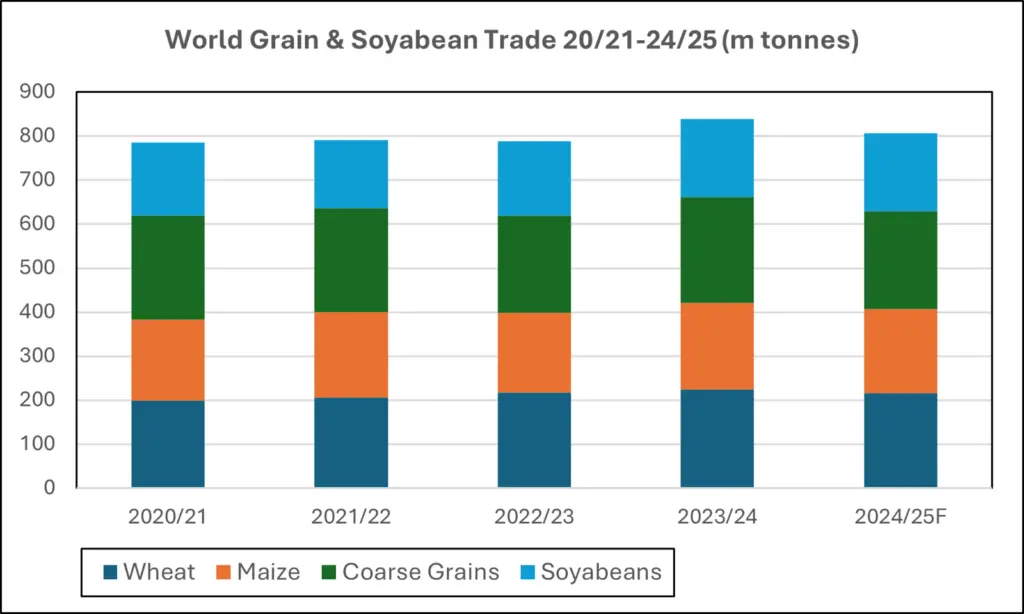
It’s worth summarising the overall development of demand. Grain trade is of course more than just wheat, with the feed sector dominated by soyabeans and coarse grains. Overall volumes are summarised in Figure 1, which brings together total volumes for the period since 2020/21 (USDA data). The overall profile is fairly constant, with total tonnages increasing from 785m tonnes to an estimated 807m tonnes in 24/25. There have been some short-term changes, but a steady growth trend is apparent.
A closer examination of the statistics reveals that the major driver of the increase has been wheat trade for human consumption, with volumes increasing from just under 200m tonnes to a peak of 224m tonnes in 2023/24. This represents an increase in market share from 25 to 27 percent. Although a limited downturn is forecast for the current crop year the underlying trend is apparent.
The real sensitivity is in the wheat trades and the direct human effects of trade disruption. Table 1 summarises the development of exports and imports by major country over the period.
| 2020/21 | 2021/22 | 2022/23 | 2023/24 | 2024/25F | |
|---|---|---|---|---|---|
| Source: USDA | |||||
| Exports (million tonnes) | |||||
| Russia | 39.1 | 34 | 49 | 55.5 | 48 |
| USA | 26.6 | 21.3 | 20.3 | 19.6 | 22.5 |
| EU | 29.7 | 31.9 | 35.1 | 37.9 | 30 |
| Canada | 27.7 | 15 | 25.3 | 25.7 | 26 |
| Australia | 12.7 | 26 | 33.3 | 22.5 | 25 |
| Ukraine | 16.9 | 18.8 | 17.1 | 18.6 | 16 |
| Argentina | 9.6 | 17.7 | 4.7 | 7.3 | 15.5 |
| Others | 37.3 | 41.5 | 32.9 | 37 | 32.8 |
| Total | 199.6 | 206.2 | 217.7 | 224.1 | 215.8 |
| Imports (million tonnes) | |||||
| China | 10.6 | 9.6 | 13.3 | 13.6 | 12 |
| Egypt | 12.1 | 11.3 | 11.2 | 12.3 | 12 |
| Indonesia | 10 | 11.3 | 9.4 | 13 | 12 |
| EU | 5.4 | 4.6 | 12.2 | 12.6 | 11.5 |
| Algeria | 7.7 | 8.5 | 8.7 | 9.5 | 9 |
| Morocco | 5.2 | 4.7 | 5.8 | 6.2 | 7.5 |
| Philippines | 6.1 | 6.9 | 5.8 | 6.9 | 7.2 |
| Others | 142.5 | 149.3 | 151.3 | 150 | 144.6 |
| Total | 199.6 | 206.2 | 217.7 | 224.1 | 215.8 |
Within an overall growth profile – and accounting for typical year-on-year climate-based volatility – it’s clear that the major trend over the period has been the development of Black Sea exports until 2022. The combined shipments of Russia and the Ukraine had become the dominant world suppliers, with the focus of most of this demand being either shorthaul into North Africa and the Middle East or in fragmented demand to smaller markets – usually in Handysize bulkers.
With this supply side analysis, we also see the volatility of Southern Hemisphere suppliers where sharp year-on-year production shifts are well known. Only the North American suppliers – especially the US – have the potential to increase production and shipments to reach levels achieved in the past.
Turning to imports, the primary trend has been the steady increase in Chinese demand, although as the economy weakens these volumes are now more uncertain. The real drivers have been the rapidly increasing populations in the grain-deficit regions of the Mediterranean (Egypt, Algeria and Morocco) and SE Asia. Here demand is continuing to grow, and this can only be met by further increases in imports.
UKRAINE AND THE BLACK SEA
Since the beginning of the Russian invasion of Ukraine, in February 2022, Ukrainian grain exports have been disrupted. Initially, Russian naval vessels sought to block shipments from Ukrainian ports. The political price was high, with Russian ‘allies’ in the identified markets facing at least short-term disruptions. This resulted in a four-month agreement between the UN, Turkey and Russia to allow exports via a ‘safe maritime humanitarian corridor’ – the so-called Black Sea Grain Initiative. Some 950 grain bulkers left the Ukrainian ports of Chornomorsk, Odesa and Yuzhny during the period – with this accounting for at least 30m tonnes shipped during the period of the initiative. Around 65% of the wheat exported under this arrangement was for Developing Countries, while maize was exported almost equally to developed and developing countries.
On 17 July 2023, Russia announced its decision to end the Black Sea Grain Initiative.
Following the cessation of the Black Sea Grain Initiative vessels have since been using an alternative route, hugging Ukraine’s southwestern Black Sea coast through Romanian waters and on to Turkey. Although this remains a relatively safe routing the vulnerability is currently primarily in the load ports which are fixed and easy targets. The outcome of this scenario remains uncertain, but insurance is up again and there has been a limited spike in grain prices from these sources.
Direct reaction from the Ukraine on Russian export ports would radically worsen the situation and have the potential to see a partial curtailment of Black Sea grain shipments. This would have far-reaching effects and result in the situation first feared when the invasion commenced.
Since early October things have got worse. Obviously reflecting on a general lack of progress in the campaign, in October the Russians launched a ballistic missile attack on the port facilities at Chornomorsk, the third attack on the region within a four-day period. Ukrainian officials also report a Russian missile hit a Palau-flagged vessel in Odesa port, killing one Ukrainian national and injuring five foreign nationals. In addition, a Russian missile damaged a civilian Saint Kitts and Nevis-flagged vessel loaded with corn in the port of Pivdennyi in the same region.
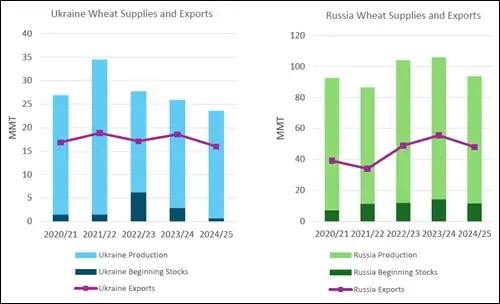
Under these circumstances projecting demand is highly problematic. The latest USDA forecasts (compiled before the increased tension) indicate that until recently Russian moves to restrict grain shipments from the Ukraine were largely ineffectual (Figure 2). Although production has declined, actual exports have remained at established levels. In contrast, Russia has been able to increase shipments to some extent.
As we move towards the end of the year, continued monitoring of the Ukrainian situation will be essential. Until recent developments trend lines suggested that the Ukraine was on a strong trajectory, but intensifying war conditions and potential disruptions pose mounting risks.
Overall current indicators point towards a successful year for Ukrainian exports, contributing positively to the global supply chain and economic stability in the region. This is probably directly responsible for the recent attacks as Russia seems unable to strike at vessels transporting the grain and is focusing its efforts on the port sector itself.
So, what are the possible outcomes?
- If the war is settled – either by a victory or ceasefire – then grain volume will recover sharply as both players seek to lift export earnings despite some uncertainties over production volumes. Under these conditions, recovery and renewed investment in Ukraine’s grain export terminals will be to the fore.
- On the other hand, a continuing attrition will only see further strikes on major grain export terminals provoking a direct response from Ukraine. Under these conditions the Black Sea share of the grain trades will fall sharply – as was feared in 2022.
It’s not possible place a bet on the likely outcome, but the grain trade has never looked more vulnerable. Production in the US (and other suppliers) could be increased, but the lead times for grain are long and the world stock situation is not favourable
IMPACT ON PORT INVESTMENTS
The world grain trade has become complacent. The immediate impact of the upheavals in the Black Sea were limited and saw an increase in prices which offset some of the downside for the major grain traders. However, it is clear that the level of risk in the trades is much higher than was thought to be the case as recently as two years ago.
It is also clear that there is a requirement to step up not just remedial investments in Ukrainian ports (which, in any case, needed significant improvement) but also in the alternative suppliers. Capacity exists in the US and Canada – although some uprating of under-used export elevators will be required – but other suppliers such as Argentina need to step up there long delayed investments in programmes to, for example, deepen the River Plate. Other capacity additions must be made to offset the direct risk stemming from Ukraine’s unhappy position.
However, focusing financing for such developments will be problematic until the risk is right in front of us. It may be too late.
Related Articles
 WORLD
WORLD
 WORLD
WORLD
 PRODUCTS & SERVICES