

Carbon capture: A bonus cargo?
What are the realities associated with carbon capture directly onboard vessels? Co-authors
Diederik Westerkamp and Johan-Paul Verschuure, of the Rebel Group, chart the pros and
cons of securing this new cargo stream.
What can capturing carbon emissions directly onboard the vessel mean for the port industry? Pilot projects are underway to examine feasibility.
Onboard carbon capture could turn this CO2 into a new cargo flow for ports: large container ships calling at Rotterdam alone could bring around 1.7 million tonnes of it a year by 2050. Other vessel segments will only add to this volume.
Yet this new business model may not be for everyone.
Only ports combining large throughput with carbon storage projects will be able to create enough demand to reach the threshold for investing in the industry in the medium term. The business case for liners is complex and risky still as every CO2 tank takes space from containers, forcing a trade-off between lost slots and saved carbon allowances- now and in the future.
A new cargo for ports?
The energy transition is reshaping the cargo flows through ports, and one new flow comes from ships themselves: CO2 captured on board. Zero- and near-zero-emission (ZNZ) fuels may not be available in sufficient volumes for years, or only at a high cost, and part of today’s fleet is expected to still be sailing on conventional fuels in 2050.
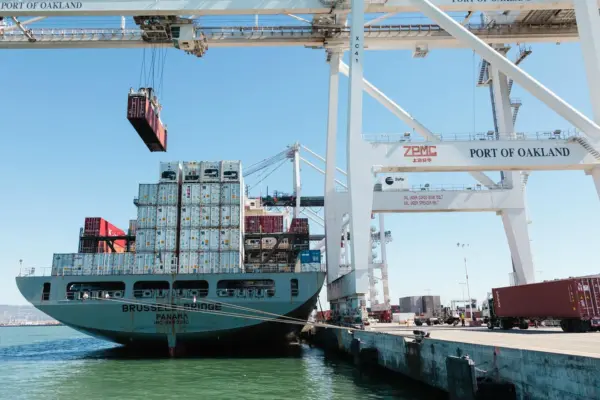
Onboard carbon capture and storage (OCCS) brings industrial capture technology to shipping. A solvent absorbs the CO2 from the exhaust, after which the CO2 is liquefied (LCO2) and stored in tanks until the ship reaches a port that can send it on to permanent storage. By 2025 some 60 vessels were fitted with OCCS, according to DNV. The 14,000 TEU (twenty-foot equivalent unit) container ship EVER TOP has offloaded LCO2 in pilot schemes in Shanghai and Rotterdam.
How much CO2 comes ashore, and when, depends on the fuel mix of the fleet, how many owners install the system, which service loops their ships sail, how many ports along the route can take LCO2, and whether rules outside Europe reward running the system for the whole voyage.
How much CO2 should come ashore?
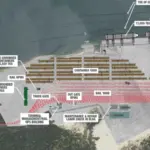
To gauge the scale, we took the roughly 750 calls by container ships of over 12,000 TEU at Rotterdam in 2025, as reported by Alphaliner, and assumed that 40 per cent of these calls will be made by ships retrofitted with OCCS by 2050. They would bring around 1.7 million tonnes per annum (mtpa) of LCO2 to the port, requiring one hectare of buffer storage.
We focused on ships running on conventional fuel oil, such as heavy fuel oil (HFO) or very low sulphur fuel oil (VLSFO), as these are the ships on which OCCS will likely be installed, mostly as retrofits.
The technology is still at an early stage and needs further development. We assumed that the system captures three quarters of the CO2 in the exhaust. We assumed the capture plant causes the vessel to consume a quarter more fuel on top of what the ship burns for propulsion, in line with the life cycle assessment (LCA) guidelines of the International Maritime Organization (IMO)[1]. Storage is based on a published Mitsubishi Shipbuilding design of two 2,700 m3 tanks. Upscaling of the technology to large container ships is yet to be proven. According to the International Chamber of Shipping, gas carriers and large tankers are also interesting candidates, given their available space and energy profile.
The figures referenced here cover only large container ships. With faster uptake, or with tankers, bulk carriers and car carriers joining in, volumes could triple.
LCO2 hubs decide where it lands
The 1.7 mtpa from large container ships is a significant volume, but most of the CO2 handled at LCO2 terminals such as CO2next will come from industrial emitters. Their volumes, and access to storage sites, decide where large-scale carbon capture and storage (CCS) projects and their LCO2 terminals are built. OCCS adds upside to these terminals rather than a base load.
OCCS also brings new barge movements. Container ships call at their own terminals, so their LCO2 has to be pumped into LCO2 barges alongside, much like bunkering in reverse. That means fitting transfers into tight terminal schedules, safety zones, enough barge and berth capacity, and coordination between terminal and barge operators.
Regulation is still catching up. EU law exempts CO2 for geological storage from waste-shipment rules, also when it arrives from outside the EU, as long as it is stored in line with the EU CCS Directive. The EU Emissions Trading System (EU-ETS) counts it as not emitted once it reaches a permitted storage site. Offshore, the London Protocol only allows export for sub-seabed storage under bilateral arrangements, such as those between North Sea countries. Outside Europe, it is still unclear how captured CO2 will be credited. Singapore is working towards bilateral agreements with Indonesia and Australia to ship CO2 abroad for storage. Globally, the IMO is developing a regulatory framework for OCCS, due by 2028.
OCCS discharging will concentrate in a few ports that combine large shipping traffic, of any vessel type, with LCO2 offloading by barge and a dedicated LCO2 terminal or CCS project. On the Asia–Europe route, these are Singapore and North Sea ports linked to storage projects such as Aramis and Northern Lights, as well as the UK’s Northern Endurance Partnership.
Lost boxes versus saved allowances
The two 2,700 m3 tanks of the reference design occupy roughly the space of 80 FEU (forty-foot equivalent units), worth some €250,000 in freight revenue per trip at today’s Asia-Europe rates. Against
that, CO2 kept on board needs no emission allowances. Under the EU-ETS, voyages between an EU and a non-EU port count for 50 per cent of their CO2 emissions. At today’s carbon price of around €85 per tonne, OCCS saves a similar amount per trip in EU-ETS costs.
FuelEU Maritime does not recognise OCCS yet, so a ship on fuel oil with OCCS still pays FuelEU penalties, as the fuel itself remains fossil. The European Commission will consider including OCCS in its review of the regulation, due by the end of 2027.
that, CO2 kept on board needs no emission allowances. Under the EU-ETS, voyages between an EU and a non-EU port count for 50 per cent of their CO2 emissions. At today’s carbon price of around €85 per tonne, OCCS saves a similar amount per trip in EU-ETS costs.
FuelEU Maritime does not recognise OCCS yet, so a ship on fuel oil with OCCS still pays FuelEU penalties, as the fuel itself remains fossil. The European Commission will consider including OCCS in its review of the regulation, due by the end of 2027.
that, CO2 kept on board needs no emission allowances. Under the EU-ETS, voyages between an EU and a non-EU port count for 50 per cent of their CO2 emissions. At today’s carbon price of around €85 per tonne, OCCS saves a similar amount per trip in EU-ETS costs.
FuelEU Maritime does not recognise OCCS yet, so a ship on fuel oil with OCCS still pays FuelEU penalties, as the fuel itself remains fossil. The European Commission will consider including OCCS in its review of the regulation, due by the end of 2027.
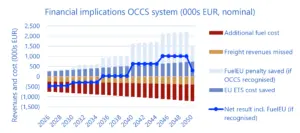
A flow to watch
Onboard carbon capture could add a meaningful new cargo flow within one or two decades – if only to support efforts of liners to decarbonize and provide an alternative to low carbon fuels. It will however, especially hinge on the success of existing CCS projects and will require higher emission taxation.
How meaningful the new business will be, will particularly hinge on the price of carbon and getting all regulations in place, the pace at which clean fuels arrive and the number of ports able to take the CO2. The winners are likely to be ports that combine large shipping traffic with LCO2 offloading by barge and working in conjunction with a dedicated LCO2 terminal or CCS project. For interested parties, the task is to start planning the infrastructure and logistics now. As with any type of infrastructure, the planning of this typically takes longer than new technologies to develop.
1The IMO Guidelines on life cycle GHG intensity of marine fuels (LCA Guidelines) set out how
the well-to-wake greenhouse-gas emissions of marine fuels are calculated. They were first
adopted in 2023 (resolution MEPC.376(80)) and updated in 2024 (resolution MEPC.391(81))

Related Articles
 GREENPORT CONGRESS
 DECARBONISATION & SHOREPOWER
 PRODUCTS & SERVICES