



Turning heads
Oakland is trying to divert attention away from the more familiar west coast ports of Los Angeles and Long Beach, writes Alex Hughes
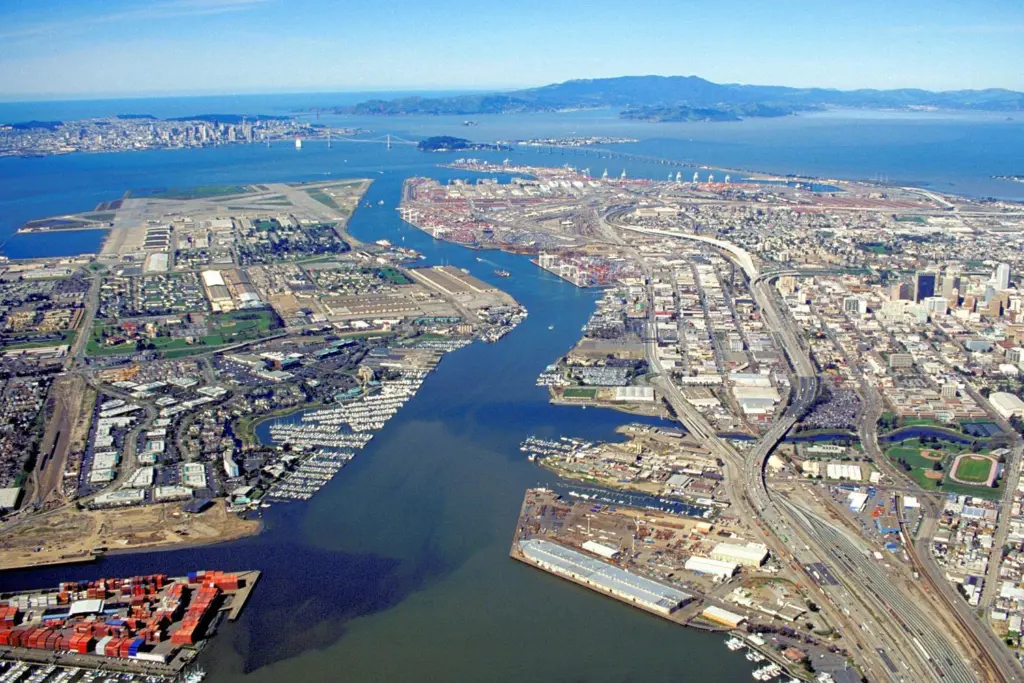
The US Port of Oakland has long sought to increase its competitiveness and attractiveness as a first port of call on the west coast. However, with 70% of California’s population located in the south of the state, Long Beach and Los Angeles dominate current maritime trade, especially since 55% of total cargo entering the two ports is consumed locally.
Given that its own hinterland is not sufficiently large enough to make it a natural first port of call for vessels, Oakland has had to look at distinct ways of expanding this. The logical move was to develop intermodal strategies involving rail.
It therefore took the decision to redevelop the adjacent former Oakland Army Base as an outer harbour intermodal terminal. While the terminal is considered an off-dock area, it nevertheless falls within the competence of Oakland. Significantly, compared with on-dock terminals, “off-dock” facilities can generally handle twice as many containers annually. In terms of project difficulty, a series of grade separations, which will form the initial project phase, are required to facilitate construction and operation of any intermodal terminals. While feasible, these are not easy to implement.
Two separate projects in this zone will nevertheless be taken forward as public-private partnerships linked to developmental agreements with long term tenants. This is a departure for Oakland, which has historically mainly funded development through tax exempt revenue bonds. The terminal land will be leased to rail operators, with increased revenues from the expanded operations ultimately paying for the capital expansion.
Full implementation is expected to take eight to ten years, although the initial schedule is being driven by the state’s requirement that projects financed with Prop 1B funds be under construction no later than 2012.
For the conceptual design, consultant DMJM Harris, working with Parsons as part of the port’s own design team, was asked to investigate alternative operating modes.
Robert Johansen, DMJM Harris’ Marine Planning director, who acted as project manager for this programme, explains that one of the concepts that was eventually proposed incorporated electric powered automated crane technology, which is both environmentally friendly and operationally economical. To date, such technology has not been widely implemented in the US pending modifications to the current working rules in maritime facilities. However, both the port and rail operating companies were interested in its potential adoption.
“The growth in world trade, along with the deployment of larger container vessels, is driving a need to expand intermodal rail facilities on the west coast to meet both current and projected US demand. By developing the inland terminal, the Port of Oakland is planning to capture a larger share of the intermodal traffic passing through gateway ports on the West Coast,” says Mr Johansen.
He adds that, while Oakland is well placed to accommodate this growth, there are a number of issues regarding rail improvements between the port and transit of the Sierra Mountains that need to be addressed, as the capacity of the existing infrastructure could be a limiting factor for the smooth flow of rail freight from the inland terminal into the heart of the US. However, as for the uptake of automated technology, he says its adoption would undoubtedly allow Oakland to grow its business in an environmentally responsible and economical manner.
“An automated inland terminal will allow the port to offer better service and achieve higher growth levels within the confines of its current footprint. This is especially true given the environmental challenges we are now addressing, which are starting to limit the growth of ports in Southern California,” says Mr Johansen.
For its part, Halcrow has been asked to provide planning, design and related consulting services for development of the inland terminal. Union Pacific plans to operate one of the two planned intermodal terminals given the proximity of the development area to the its mainline, which literally runs 100 feet from the former Oakland Army Base, providing unsurpassed access for movement of unit trains directly on to the general railroad network.
If the two planned rail terminals do eventually feature wide span gantry cranes and a semi-automated terminal operating system, subsequent infrastructure could be put in place allowing 8,000 foot long trains to be assembled without the need to undertake complicated manoeuvring, says Halcrow.
Related Articles
 NEWS
NEWS
 CONTAINER & CARGO HANDLING
 OPERATIONS