



Trading in Environmental Space
In order to expand the activities at a port and industrial estate, environmental space is needed in addition to physical room. At the Moerdijk and Amsterdam-Westpoort Port and Industrial Estate, there is still sufficient ground available for new development. However, the port authorities expect that the environmental space will not allow for any new activity in the near future if no action is taken, says Jacco Rentrop, Spatial Development and Environmental Manager of the Port of Moerdijk Authority.
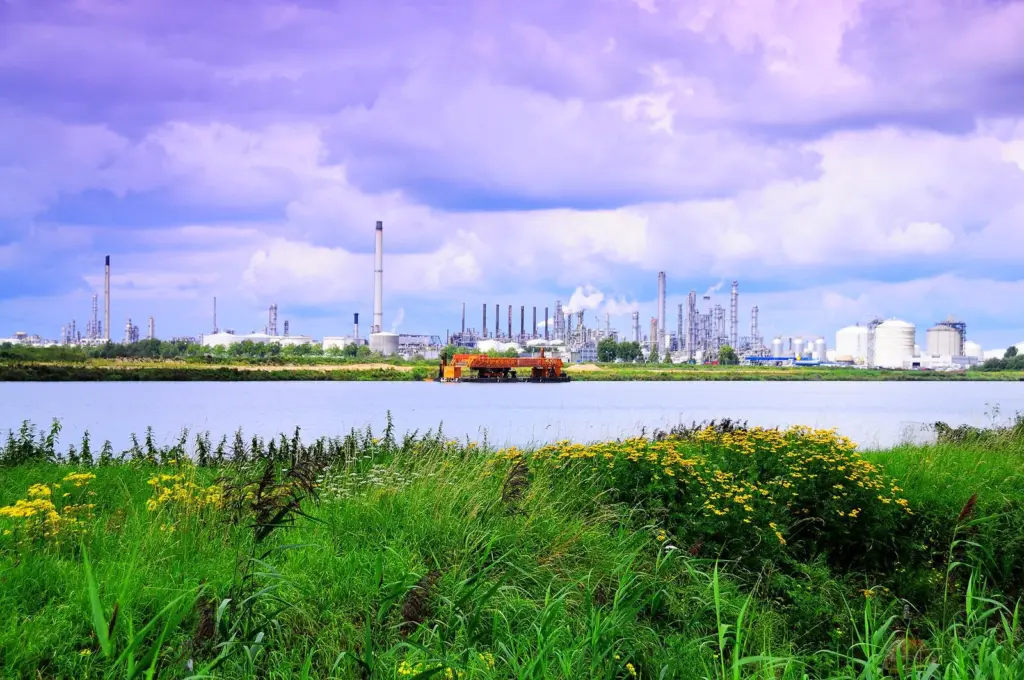
Both the Moerdijk and Amsterdam-Westpoort Port and Industrial Estatehave joined hands to find a solution to the situation. Investigation is underway as to whether trade in environmental space, more specifically noise space, is possible.
In the last ten years, the storage and transhipment capacity in the Moerdijk Port and Industrial Estate has increased from 6 to 21 million tons. There are still large plots of wasteland. If this land is brought into distribution, the storage and transhipment capacity will be able to continue to increase to 30 million tons in the next ten years. There is, however, one condition: the Moerdijk Port and Industrial Estate is located in a noise zone. For each company, the allowable amount of noise has been defined. If you take the figures into account, there is little or no room for establishing new companies or for expanding the storage and transhipment capacity of existing companies. However, this noise space is, in practice, not being fully exploited. If you look at the real noise emission of the entire area, there is actually room (latent noise room) for expanding activities. Unfortunately, individual companies strictly comply with the noise space laid down in the permit, even when they have no possibility to use this space themselves.
SUPPLY AND DEMAND
The companies are unwilling to simply give up this excess noise space, frightened to face higher restrictions in the future, when they make plans for expansion or adjustments. Nevertheless, the likelihood that they are actually going to use the excess noise space is, in many cases, small. Another issue is that companies currently lack the incentive to create noise space by taking noise-reducing measures. The Moerdijk Port and Industrial Estate is, therefore, looking for opportunities to trade the noise space that is not being used.
The Port of Moerdijk Authority has, for this purpose, joined forces with the Port of Rotterdam Authority. By assigning a value to noise emission and, consequently, to noise space, it becomes an economic factor. In this way, you make it attractive for companies to give up the rights to the noise emission that they do not use in practice. In addition, companies will be able to calculate whether to pay to implement noise-reducing measures and to trade in the noise space which becomes available as a result. An intrinsic value will be assigned at the start; supply and demand will eventually determine the value. Obviously, the noise emission will be traded in accordance with the valid noise contours. Houses located in the vicinity of the zone are not to be burdened more than the noise contours allow.
ENSHRINEMENT IN LEGISLATION
Before trading in noise emission rights becomes actually possible, a lot of work still needs to be done. The preliminary investigation into the plusses and minuses is in full swing now. Especially the enshrinement in law is a complex matter. In the current situation, the emission rights are organised per company: the amount of noise emission rights for each installation has been laid down for each installation in a permit. This has to be unlinked. I can imagine that a zone management plan is being drawn up with a foundation that acts as an independent party to ensure a fair distribution and trade in noise space.
Preliminary inquiry has already shown that this fair distribution does indeed offer much to be learned. In the first place, it was not easy to gain insight into the noise rights that were granted. Furthermore, it also immediately became clear that noise emission and surface area are not linked at this moment. This means that if a company wants to establish a business on a relatively small plot of land but needs a lot of noise space, it will be granted permission if this still falls within the noise zone. What may happen in this case is that there may still be land available in addition to the one occupied by this newcomer, but another company will not be able to settle there because the ‘neighbour’ has taken up too much noise space. That’s why we are looking for a way to set a fixed maximum noise space per square meter.
The Environmental Manager expects the investigation, involving, among others, 10 companies, to be completed in April 2013.If we want this plan to succeed, all the companies at the estate have to be willing to transfer the individual noise space to a collective space, even if not every company has something to trade in. In addition, we hope that by spring 2013, we will have a clear notion of what has to be changed in terms of legislation. In the Netherlands, an Environment and Planning Act is currently in preparation. A complex law that covers, among other things, everything that involves spatial planning. We engage administrators who are working on this law in our plans and we regularly inform them about our ongoing experiences, so that they can take this information into account when preparing this law.
Finally, we shall be able to determine on the basis of the outcome of the investigation whether a methodology can be developed to trade in other types of environmental space as well, such as air emission. For the time being, the plans of Amsterdam- Westpoort and Moerdijk to trade in emission rights are unique. However, if we succeed in developing a good structure for marketable environmental space, then other port and/or industry grounds will definitely be able to reap the benefits from this.
Related Articles
 ALTERNATIVE FUELS GREENPORT