

The Paper Chain
Stora Enso, producer of pulp, paper, packaging and forest products, hopes to realise significant cost savings with its new North European Transport Supply System (NETSS), as David Foxwell reports.
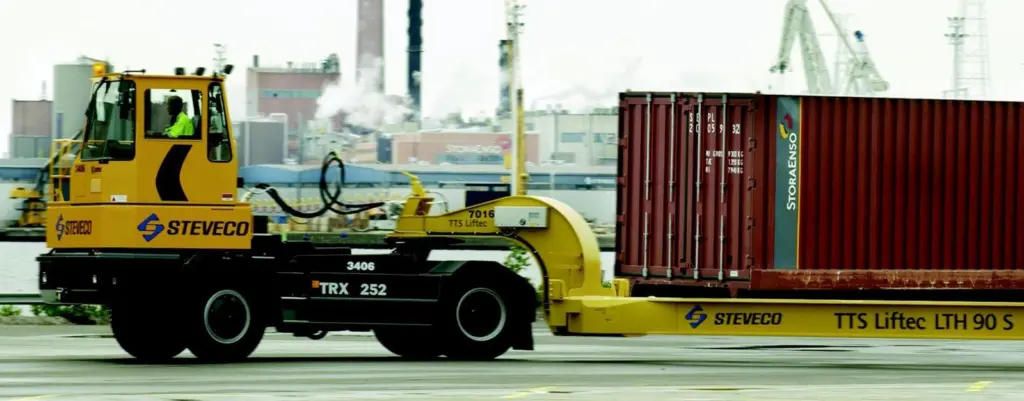
With numerous paper mills across Finland and Sweden producing pulp, paper, packaging boards and wood products, the logistical demands on Stora Enso’s transportation and distribution division are gargantuan. Stig Wiklund, project manager for NETSS explains the requirement for the reorganisation of the company’s distribution arose in 1998 when Stora and Enso merged.
“What we wanted to create was a fully integrated, joint distribution system for all our mills, in Finland and in Sweden, ” he explains, “making use of the hub and spoke principle, rather than having products from our Finnish mills using one transportation network, and those from our Swedish mills using another.” The magnitude of this task is evident from the fact that Stora Enso has 10 mills in Sweden and 15 in Finland.
“The main aim is to create a joint spoke structure for our mills in Sweden and Finland that will facilitate a harmonised approach to supply chain management and a joint structure of distribution centres with our strategic inventories, ” Wiklund says. “These distribution centres are located close to our customers in UK and Western and Central Europe, and when all the Nordic mills have access to the distribution centres it will open up greater flexibility for production streamlining, as well as enabling us to be both more reliable and responsive to the requirements of different customers.”
NETSS will also help Stora Enso combat increasing transportation costs (bunkers for example), overcome traffic congestion at various locations and help the company meet the increased customer demand and competition it expects to experience.
The ‘hub’ selected for both countries is Gothenburg where a new ro-ro berth with linkspan is being built (as are new ro-ro facilities that Stora Enso will use at a number of Finnish ports).
But there is much more to NETSS. The company is well known for its use of specialised containers or Stora Enso Container Units (SECUs), a weather-protected cassette designed for the Baltic and North Sea that can also be carried on rail; and SECUs – with their ability to be ‘cross-docked’ quickly and easily from rail to ship – form one of the key elements of NETSS.
Another key element is a new generation of ro-ro vessel. In NETSS, ro-ros will be loaded and unloaded on two levels simultaneously in order to shorten time in port.
As an example, Gothenburg-Kotka-Gothenburg can be accomplished in 46 hours with a turnaround time of just 10 hours, carrying a maximum of 85 SECUs and 30-40 trailers. Once the current and planned second phase of NETSS have been implemented, the system will use no less than 18-20 ro-ro vessels.
Ships leaving Gothenburg will sail to Lubeck, Zeebrugge and Immingham, but the facilities that have been built for the project at Tilbury are the most capital-intensive. Project Enterprise was declared operational early in July. Stora Enso will use the port’s new Enterprise Terminal – the world’s first automated paper terminal – as the main entry port in the UK to handle newsprint and paper.
YEARS TO ACHIEVE Designed and built for Stora Enso, the facility is the only one of its kind and contains many new functions and developments which have taken three years to achieve. The new terminal includes a fully automated high-bay warehouse with 29,000 bays to accommodate newsprint and palletised paper, as well as a low-bay warehouse. Shipments of paper on pallets and reels will pass through this entry point, and the equivalent of three vessels-loads can be accommodated at the terminal at any one time, with each having the capacity to transport 196 SECUs, each SECU having a capacity of 80 tonnes of paper or board – a 24-hour operation that will be run by just 79 people.
Automation is the key, with a three-tier management system integrated into the warehouse organisation. Cranes and robots ensure minimal manual handling, hence reducing damage with, for example, a driverless computer-controlled clamping system automatically controlling the clamp force without any driver action and using preprogrammed factors based on roll weight and paper type.
Palletised goods are handled on a conveyor belt system which can optimise spread of workload with sensors deciding which pallets are available.
DFDS will be principal carrier whilst Finnlines have a one-year contract to handle some of the throughput that is not yet shipped in the new SECU giant containers. The terminal has two ramps allowing for six vessels per week to be accommodated. Initially, empty SECUs will be returned, however in the future these may be returning loaded with waste paper.
A rail cross-dock facility will be provided – creating a multimodal transport network so that Stora Enso can also distribute paper nationally by rail – enabling it to move in the region of 180-200,000 tonnes annually.
Phase 1 of NETSS may be underway, with 2 and 3 already planned, but Wiklund says these phases of the ambitious project are unlikely to be the last. He notes for instance, that Stora Enso’s exports to Spain are currently served by no less than five different supply routes, and that transportation efficiencies of the type that NETSS will provide can be realised wherever Stora Enso has major volumes to ship.
Related Articles
 NEWS
NEWS
 CONTAINER & CARGO HANDLING
 OPERATIONS