

Pushing the right buttons
The flow of information a port needs is simply pushing electrons around, says Michael Schwank. Pushing the right ones in the right direction will make life easier for all concerned.
The perfect example is on-line check-in for airline passengers. Checking in before you arrive, and having the right bags, makes the process altogether simpler. “Then when you arrive with an oversize bag, you’re an exception, and it takes longer to process you.”
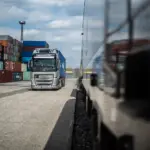
He also advocates looking at the gate “on the ground”, and making certain there are enough lanes for the number of movements a port needs to have.
Having a “people-free” gate is possible – perhaps even desirable, from a health and safety point of view – but achieving it takes a high degree of sophistication. “Having no people in the lane is safer and cheaper. You can use voice technology to talk to the trucker, and it shrinks the overhead.
“Lots of folks are getting there incrementally,” he says, although he stresses that is not necessarily the case in state-run ports, because they don’t need to operate in profit quite so urgently as those in private hands.
But although all of these solutions, from whatever provider, are effective, it is Michael Schwank’s view that they should be chosen with care and with half an eye on the ROI they’re likely to generate.
“Don’t just spend. Always look at the return on your investment; it’s important to apply solutions that fit,” he says, pointing out that what is the right solution for one terminal might not be the same for another.
“The key issue is capacity, and applying a solution to fit the problem. We look at the flow of information and what the client needs. For example, you could fly from Seattle to Atlanta in a space shuttle, but a 737 would be a better way to get there.
“The key theme is ROI. Technology is of no use if it doesn’t deliver operational benefit,” he adds.
So what’s the next big thing to help in preventing and eliminating gate bottlenecks? It is the way in which ports will be able to choose to automate functions, predicts Mr Schwank. “We’re looking at plug-and-play solutions to provide commercially viable bundles and packages that suit individual terminals.
“Ports like Singapore are great showpieces with huge staffs. Smaller ports don’t need what those big ports need. Take Richard Branson. He doesn’t want to be NASA; he wants repeatable spaceships. We want to be more like Richard Branson, and move towards plug-and-play automation.
“You have to be innovative to build better mousetraps,” he adds.
Related Articles
 CONTAINER & CARGO HANDLING
 OPERATIONS
 OPERATIONS