

Owners turn their attention to ‘Greener Tugs’
It’s just a year since the world’s first true ‘Hybrid’ tug entered service with Foss Maritime in the USA. This important milestone created considerable interest in the towage industry and occurred at a time when the industry was experiencing a period of almost frantic growth in the numbers of new tugs under construction for use in the shiphandling and the offshore markets.
With that intense period of construction now subsiding, owners, designers and specialist shipbuilders have been turning their attention to new challenges. Operators, many with large fleets of relatively modern tonnage, are facing a raft of new demands to improve fuel efficiency, reduce carbon dioxide and other exhaust gas emissions and operate vessels that are in all respects ‘cleaner and greener’.
The shiphandling sector in particular is being forced to react positively to ‘warning shots’ fired by port authorities, governments and public opinion around the world. The ports of Los Angeles and Long Beach were among the first to take substantial steps, setting emissions targets not only for land based trucks and plant but also harbour craft and eventually visiting ships. It is no accident that the unique Foss Hybrid tug Carolyn Dorothy, now operating in the Californian ports, was part funded by the port authority and state. Higher environmental targets are also being put in place by many other ports around the world, setting increasingly stringent targets for the future.
Among the majority of tugowners there has been a gradual but positive shift in attitude. Tighter environmental standards will have to be met and from the many preliminary studies being done it is becoming self evident that with measures taken to reduce emissions come real commercial benefits in terms of reduced fuel costs and improved operational efficiency.
It is obvious that a dramatic shift to new ‘state of the art’ hybrid tugs will not happen overnight. Considerable research and development is taking place and new designs are emerging but funding prototype construction is the sticking point for most tug owners. In the meantime many operators are already putting in place interim measures that are delivering improvements in emission control and fuel efficiency.
This article attempts to give a brief overview of the work that is taking place and a just a few examples of what is being achieved.
The short term
Many tug operators have reacted to the demands for higher environmental standards by assessing ‘what can be done in the short term’, whilst making plans for the future.
Virtually every study has resulted in the operator carrying out a detailed appraisal of the operating profile of the tugs in any particular fleet and location. With the benefit of 20/20 hindsight the results are both startling and obvious. Even the most modern harbour tug spends very little of its time using anything approaching ‘full power’, as little as 7% in some cases. The majority of the time is spent with the engines idling, using reduced power while station keeping, and moving between jobs. These are matters of great importance to the designer of any new ‘hybrid’ but can be improved to some extent by operational changes.
A first step for many users has been a switch to low sulphur fuel oil to reduce harmful emissions and to change operating procedures to cut fuel consumption. Dutch tugowners Kotug International BV, who already use low sulphur fuel oil, recently won a ‘Fuel Saving Competition’ sponsored by the Dutch Inland Shipping Industry. A group of four participating tugs of the Kotug ‘SD Shark’ class succeed in saving no less than 12% fuel during a six month period. This was achieved by creating fuel awareness among the captains, the use of fuel meters to show in real time the extra fuel usage when the tug accelerates and better planning and communication during vessel operations. The competition is part of a bigger plan to save energy by using vessels in a more efficient way.
The use of auxiliary machinery for electrical power generation is also an area that bears close examination. Many harbour tugs employ two diesel powered generators, running alternately, to provide electrical power throughout the period the vessel is on duty, whether working or alongside. The use of shore power while the tug is alongside can provide major savings in, fuel, exhaust emissions, maintenance and repair (MJ – July 2009).
Crowley re-engine programme
Another short to medium term remedy, used widely in the USA, is to carry out an extensive vessel rework programme including re-engining.
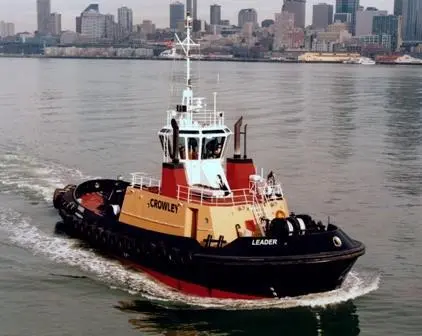
Crowley Maritime recently embarked on an engine replacement project as part of the Port of Los Angeles clean air quality initiative requiring vessel operators to upgrade their engines to be Tier II emissions compliant by 2013. ‘Leader’, the first of four Crowley Harbour class shiphandling and escort tugs has re-entered service after a complete change of main engines and auxiliaries.
The project to re-engine each tug each tug will cost Crowley more than $1m and is partly funded by a portion of a $4m Port of Los Angeles Air Quality Mitigation Incentive Program air quality improvement grant. The measures will reduce particulate matter emissions by 3.24 tons and mono-nitrogen oxides by 109.52 tons per year for all four tugs, Leader, Admiral, Scout and Master, combined.
Crowley chose to replace the vessels’ Caterpillar 3516 main engines with the Caterpillar 3512. Although smaller engines in size, the vessels’ bollard pull has increased from 51 to 59 tons. The Caterpillar 3304 auxiliaries have been replaced with the new Caterpillar model C4.4 generators. Both Voith Schneider propulsion units were rebuilt and the entire refurbishment took just 28 days.
Crowley are also deeply involved in a longer term project to produce the next generation of harbour tug based an environmentally clean propulsion system fuelled by LNG.
The Foss Hybrid project
The Foss Maritime tug Carolyn Dorothy remains the only true ‘Hybrid’ harbour tug in operation anywhere in the world and is likely to remain so for the near future. Much has been written about the Foss project and only an outline is repeated here.
Carolyn Dorothy was built to an established 23.77m ‘Dolphin’ class ASD tug design by Robert Allan with a bollard pull of 60 tons. Two fully azimuthing propulsion units are powered by a unique combination of batteries, diesel generators and/or two diesel main engines. The success of this system relies on a sophisticated power management system, masterminded by AKA, to provide seamless transition from one power source to another during four modes of operation, Stop – Idle – Transit – Assist. Considerably reduced fuel consumption of close to 40% has been achieved due to the virtual elimination of idling, with all slow speed operation being carried out on electrical power only. Minimising diesel engine use also gives a consequent reduction in emissions, lower maintenance costs and dramatically reduced noise, without sacrificing operational readiness.
When approached by Maritime Journal on the possibility of further ‘Hybrids’ following on from the Carolyn Dorothy, Foss Vice President of Harbour Services David Hill confirmed that testing is continuing and the results will be presented in a paper planned for the ITS 2010 conference in Vancouver in May. He said, ‘Regarding additional hybrid new builds and retrofits, we are in discussions with several companies but have yet to ink a deal. It is very much on our radar screen and we are keen to take the next step given the success of the hybrid in Long Beach.’
Smit E3 Tug project
Worldwide maritime service provider Smit reacted positively to the need to reduce the impact of its operations on the environment and meet future targets by initiating its E3 Tug project in 2007.
The E3 (Environment-friendly, Efficient in operation and Economically viable) project began as a cooperative venture between Smit Engineering (project leader), tug builders Damen, and power and energy management specialists Alewijnse of Nijmegen.
The aim of the E3 Group is to produce a ‘future tug’ combining excellent environmental performance and an unusual degree of operational flexibility. For this, both currently existing and future technologies are being investigated. A vital first step was to quantify propulsion system behaviour, fuel consumption and emission levels for a representative spread of Smit’s existing tugs. This created an all-important benchmark. The operating profile obtained demonstrated considerable scope for optimisation. By relating that profile to user requirements it was possible to take steps to optimise the energy use/balance and refine the various design features of the E3 Tug based on that data and the E3 principles.
The options being explored under the E3 banner include hybrid propulsion, diesel-electric, LNG power and hydrogen power, and a variety of combinations. An ‘E3 Model’ was developed allowing the E3 Project Group to simulate the operating profile and test the influence of the various propulsion options on key environmental and operational parameters. The fundamental objective was to identify the most favourable propulsion configuration, yielding the greatest emission reduction. A detailed impact analysis was carried out to include the costing of improved performance in environmental terms.
The next step was then to develop a conceptual design, with Damen working on the hull design and engine layout. Smit’s aim was to turn E3 into a hard engineering project by the end of the 2009. Further progress during 2010, should lead to Damen’s construction of a prototype E3, with the design taking its place as an option available to customers.
Smit Engineering is also participating in H3T (the Hydrogen Hybrid Harbour Tug) concept.
One important issue here is the storage and supply of hydrogen as fuel. In this feasibility study, the application of fuel cells in the propulsion train is considered. LNG is also a fuel source under serious consideration, for a hybrid configuration operating in an LNG terminal context.
Damen unveil a ‘Hybrid’ option to the Chinese market
During the first week of December, Damen Shipyards unveiled two important new ASD Tug designs at MARINTEC 2009. It is one of the biggest maritime exhibitions for the Asian market and was held at Shanghai in China.
The new ASD 3212 ASIA design has been specially designed for shiphandling and escort operations in Chinese coastal waters, and is capable of working in heavy sea conditions. For the Chinese market, the 75 tons bollard pull tug can be offered with Daihatsu main engines and Yanmar propulsion units. A modern hull with inherent dynamic stability will incorporate a high forecastle and large foredeck. The tug will be fitted out for a large crew, comprising two shifts of eight persons.
Considerable interest was also shown in the ASD 3212eh design, a true ‘Hybrid’ version of the same vessel. Designed to reduce exhaust emissions to an absolute minimum, the 32.58m tug will be powered by a diesel-electric-lithium battery powerplant driving Rolls-Royce US 255CP propulsion units to achieve the same 75 tons bollard pull.
Plans for the Damen Hybrid include the use of two highly efficient MTU 12V4000M63L diesel main engines, each capable of generating 1,680kW at 1,800 rpm. Filtration systems will be incorporated to reduce NOX emissions (SCR filters) and particulates (DPF filters). The diesel engines will drive the propulsion units via ABB electric motor-generators rated at 690volts AC 60Hz, capable of delivering 730kW each at 1,800 rpm. Two LiFePo4 lithium battery packs will be installed, each with a storage capacity of 1,000kW and nominal operating voltage of 800v.
The drive-line will incorporate clutches, enabling each diesel engine and motor/generator to power the propulsion unit in unison; the motor-generator to drive the propulsion unit; the diesel engine to drive the motor-generator to recharge the batteries. Any surplus power generated during the operational cycle will also be used for battery charging.
A power management system, the Hybrid Control Unit (HCU), offers maximum flexibility in the use of the powerplant. For example, while manoeuvring, both prop units will be powered by the electric motor-generators. At low speeds or towing at low power, one prop unit will be powered by a diesel engine and one by a motor-generator. For a high bollard pull or high speed (20-70% power), both diesels will be powering the prop units. For maximum bollard pull or speed (70-100% power), diesel and electric power is used in unison.
Fuel consumption and exhaust gas emissions are predicted to be dramatically reduced when compared with a similar ‘all diesel’ vessel of a similar type, but dependent on the operational profile.
Chinese ports showed great interest in both new designs, and there is the possibility that the first innovative Dutch designed, Chinese built tug will soon be operating in Chinese waters.
The ‘Dutch Green Tug’ hydrogen hybrid
The much publicised, Dutch ‘Green Tug’ project, led by two Ijmuiden based firms, tug operator Iskes Towage and Salvage and Offshore Ship Designers (OSD), is ready for the first order to be placed.
‘To proceed it must first overcome the simple fact that going green costs money. We have the know-how to make a tug greener and we can deliver a vessel that can operate in city areas with near zero emissions’, explained Michiel Wijsmuller, managing director of OSD.
The ‘Green Tug’ is a hydrogen hybrid with electric motors driving an ASD propulsion system, powered by a mix of lithium ion batteries, hydrogen powered fuel cells and low emission diesel generators. It provides a 65 ton bollard pull and the handling characteristics of a conventional ASD tug but uses much less energy and produces much lower emissions.
‘I’m confident we shall see orders placed soon, said Wijsmuller. ‘The Green Tug specification exceeds European regulations for the cleanliness of inland waterways shipping and trucks, so it has to be the way forward. Developing the Green Tug has shown us lots of ways to improve conventional tug design to be more economical with fuel and we will certainly use that in improving conventional tug designs.’
The use of hydrogen as a green energy source increases fuel manufacturing and distribution costs, because the port has to invest in a hydrogen network. The port of Amsterdam has ambitious plans to expand lock capacity at IJmuiden and to grow the port business, so it will need more tugs. Iskes wants to be part of that and is ready to invest in cleaner technology tugs.
‘No tug operator could do that alone, concluded Wijsmuller. ‘There is a premium on the newbuilding cost of a hydrogen hybrid tug that will be substantial for the first vessels, maybe less as more are built. If a port like Amsterdam can find innovation funds to cover that premium because they want a cleaner port, then the stage is set’.
Seaspan goes for an ‘Electric Hydrogen Hybrid’
Canadian tugowner Seaspan International Ltd of Vancouver is planning to introduce an Electric Hybrid tug as early as 2012. Working with Capilano Maritime Design Ltd, DC Maritime Technologies Inc, Lloyd’s Register North America Inc, and Ballard Power Systems, the company will base the design for the new tug on a successful class of ASD shiphandling tug already in use in Vancouver.
The vessel will employ two fully azimuthing propulsion units with fixed pitch propellers, each coupled to a 1,800kW electric motor. Power for the motors will be supplied by a combination of hydrogen fuel cells, battery banks and diesel generator sets. Four hydrogen fuel cell generators will be supplied by Vancouver based Ballard Power and will be marinised versions of the company’s standard 150 kW (each) units manufactured for use in road vehicles. The fuel cells will be operated by hydrogen mixed with compressed air to provide electrical power for the drive motors or charge the batteries. Shore power will be used for battery charging when the tug is idle and when carrying out light duties the tug will operate entirely on electrical power from the batteries and fuel cells. Only when full power and the 55 tons maximum bollard pull is required will the diesel generators be used.
Developments Offshore
The offshore towage, anchorhandling and supply industry, currently suffering considerably from very low rates in areas such as the North Sea, is also turning its attention to measures that will help meet future environmental demands.
Rolls-Royce, Ulstein and other specialists in the offshore field are working hard on optimising propulsion systems to reduce exhaust gas emissions and lower running costs. In some respects the anchorhandling tug supply vessel and the more basic platform supply ship both lend themselves more readily to ‘hybrid’ options than smaller craft. The wide use of electrically powered thrusters and similar equipment makes a diesel-electric approach, with sophisticated power management systems, increasingly attractive.
Watch this space !
The foregoing gives just a taste of the developments going on in the towage industry to address environmental issues. Maritime Journal will undoubtedly be returning to the subject in the near future.
A measure of this activity is reflected in papers appearing in the conference programme for the forthcoming International Tug & Salvage Convention to be help in Vancouver in May of this year. The subject of ‘Hybrid’ technology and other environmental considerations will be high on the agenda for the several hundred delegates from all over the world.
By JM Gaston
Related Articles
 EQUIPMENT
 ALTERNATIVE FUELS GREENPORT