


Team up or bail out
New Zealand’s ports are told to consolidate or risk losing out to the Australians in the battle for booming Asian cargo.
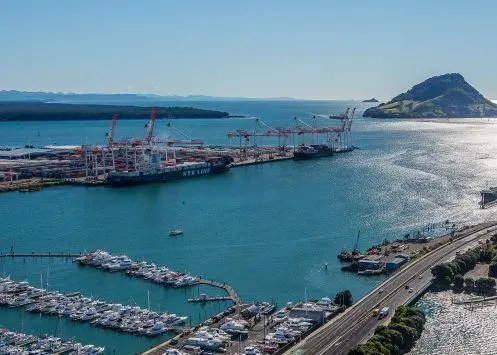
When Neville Darrow retired as chairman of New Zealand’’s largest container port, the Ports of Auckland, he issued the warning that the country’’s ports will need to consolidate, or risk becoming just feeders to larger Australian ports.
The reason, he says, is the growing pressure on ports owing to the concentration of shipping power in the hands of just a few companies worldwide.
The basis for Mr Darrow’s warning is clear to see: the enlarged Maersk Line controls 40% of New Zealand’s container trade and is in the throes of reviewing all the ports it serves in New Zealand. It currently visits nine ports – a legacy of combining its services with those operated by P&O Nedlloyd. Maersk New Zealand country manager Tony Gibson asks whether nine ports in New Zealand is the right thing. “The answer is probably ‘No’, ” he says to PS. “We’ve got over-capacity in the terminals, we’re over-capitalised and that’s not good for NZ Inc.”
Maersk calls at Auckland, Tauranga, Napier, New Plymouth, Wellington’s CentrePort, Nelson, Lyttelton, Timaru and Port of Otago.
The question is which will retain a direct call and which will be replaced by inland or coastal feeders.
Both Mr Gibson and Mr Darrow agree that there is severe overcapacity at New Zealand container terminals. Mr Darrow says the case for rationalisation is even more “compelling” given the investment required to cater for ever-larger ships. He predicts greater co-operation between the two northern gateway ports of Auckland and Tauranga, but to date port co-operation or rationalisation in New Zealand is little seen.
In February, Christchurch City Holdings (CCHL) sought to buy out all the shares in the port of Lyttelton it did not already own, and set up an operating company with Hong Kong’s Hutchison Port Holdings.
When the news was announced, New Zealand’s port sector looked set for momentous change, but that momentum appears to have been lost, with Port Otago sitting on a blocking stake in Lyttelton of 15.3%.
Otago’s move has caused HPH to (temporarily at least) withdraw.
No-one knows whether Otago will be successful in forcing some kind of co-operative agreement between the two South Island ports.
Neither does anyone know what level of co-operation the Commerce Commission will or will not allow between ports.
If any joint moves were seen as collusion it would place immediate limits on the opportunities to work in tandem. But perhaps the decisions of the major carriers will forced the hand of New Zealand’s port and force rationalisation sooner rather than later.
Related Articles
 WORLD
WORLD
 PORT & TERMINAL NEWS
 PORT & TERMINAL NEWS