






Local positioning overcomes global problems
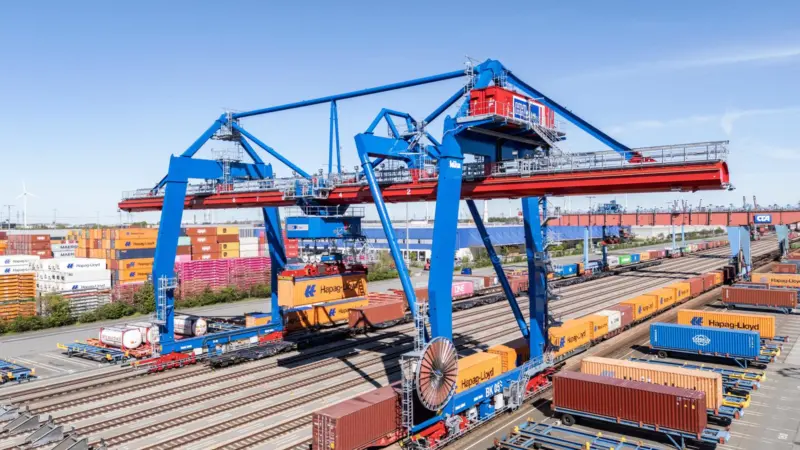
While the majority of PDS on the market adopt some sort of global positioning satellite technology, the system marketed by Germany’s Symeo uses local wireless technology to counter problems associated with some existing DGPS receivers: that they are unable to supply reliable data due to the high structures commonplace at a container terminal.

The system has recently been installed to container handling equipment at the Burchardkai Container Terminal.
In tests, Symeo’s Local Positioning Radar (LPR) system, a radio based solution that uses the free 5.8 GHz ISM band or, for 1-D precision distance measurement, the free 61 GHz ISM band, was able to track the position of containers with an accuracy of 1m. Over the course of the 14-week test, the LRP system presented the operator with an availability of 99.2% and a positioning accuracy of up to 20cm.
In time, Burchardkai’s entire fleet will be fitted with LPR positioning systems. The first ten straddle carriers will be retrofitted by June of this year, with an additional 40 vehicles benefitting from the system by the end of 2011.
Symeo also has a positioning system that uses both GPS and LPR sensor technology. In order to determine position with a standalone DGPS system, line of sight to a minimum of four satellites near to the horizon is required. With a standalone LPR system, line of sight to three transponders is required to get an accurate position. With the combined LPR/GPS station concurrently recorded signals from GPS satellites as well as LPR transponders can be used to calculate position because the LPR transponders act as local satellites.
For the first time, line of sight to only two satellites is sufficient to get a position and only two additional LPR transponders must be within reach.
Related Articles
 CONTAINER & CARGO HANDLING
 OPERATIONS
 OPERATIONS