




Environmental incentives: How winning ports shape shipping trends
Environmental incentive schemes can do more than reward cleaner vessels. Used effectively, they can help ports drive decarbonisation, strengthen environmental reporting and make better-informed decisions while supporting their competitive position. Thomas Smith, Head of Cargo Solutions at OceanScore, looks at how ports can build an effective scheme – and how Port of Aarhus is putting this into practice.
 Content from our commercial partners
Ports have an increasingly important role to play in encouraging cleaner shipping. Environmental incentives give them a practical way to turn their sustainability ambitions into action: encouraging better environmental performance from vessels, creating clearer evidence of progress for reporting, and strengthening their proposition to shipping companies investing in cleaner operations.
This is where environmental incentive schemes can become a practical tool for decarbonisation. By rewarding better environmental performance, ports can encourage shipping companies to adopt cleaner fuels, use shore power, invest in electrification and implement other technologies that reduce emissions.
Done well, the benefits go beyond emissions. Incentives can help a port differentiate its proposition to shipping companies investing in better environmental performance, keep pace as fleets adopt cleaner technologies and turn sustainability ambitions into a practical part of port strategy. These are also central themes in how the Environmental Ship Index (ESI), the most widely adopted scheme of its kind, is positioned for ports today: supporting sustainability strategies, enabling performance-based decisions and helping ports remain competitive as shipping changes.
For ports that have not yet implemented an environmental incentive scheme, the tools to do so are also becoming more comprehensive. From January 2027, the Environmental Ship Index (ESI) and Environmental Port Index (EPI) will operate as complementary modules under the IAPH umbrella on OceanScore’s shared technical platform. ESI provides insight into a vessel’s overall environmental profile, while EPI assesses environmental performance during individual port calls. Together, they give ports a broader basis for understanding performance and translating it into practical incentives.
But having the right framework is only part of the equation. Without understanding the vessels actually calling at a port and how they perform, it is easy to set thresholds that are either too demanding to motivate change or too accessible to drive meaningful improvement.
So, how should a port design an incentive scheme that works?
How should a port design an environmental incentive scheme that works?
 Best practice #1: Define the environmental outcome you want to achieve
Before deciding on a threshold (incentive level), a port needs to be clear about the behaviour it wants to encourage. Is the priority to accelerate the uptake of cleaner fuels? Encourage shore power? Reward vessels investing in cleaner technologies? Or create a broader incentive for continuous environmental improvement?
ESI 2.0 allows ports to target these outcomes more directly, with cleaner fuel use reflected in the GHG score, shore power connections rewarded through bonus points, and cleaner technologies recognised through the new Innovation component.
For ports, having a recognised framework is only the starting point. The next question is how to translate environmental performance data into an incentive structure that works for their particular vessel traffic and objectives.
Best practice #2: Start with the vessels calling your port
In an ESI-based incentive scheme, the threshold is the minimum ESI score a vessel must achieve to qualify for an incentive. There is no universal threshold that works for every port. Each has a different vessel mix, environmental strategy, incentive budget and set of priorities.
Looking at actual vessel calls can show how vessels perform and how many would qualify at different thresholds. From there, ports can assess whether the resulting incentive structure supports the behaviour they want to encourage.
OceanScore works with ESI ports to carry out these assessments, helping them understand their vessel population and what different thresholds and incentive structures could mean in practice. The objective is not to prescribe a particular scheme, but to give ports the data and insight needed to make informed decisions.
This is particularly important as shipping evolves. ESI has an improved scoring methodology that reflects developments in regulation, technology and environmental priorities, covering NOx, SOx, GHG and innovation and strengthening its links to energy use and operational performance.
Changes in methodology can also change vessel scores – and therefore affect how an existing port incentive scheme performs.
Best practice #3: Design an incentive that drives improvement
An effective scheme needs to balance ambition with accessibility. Set the qualifying level too low and it may provide little incentive for improvement. Set it too high and operators may see no realistic opportunity to qualify.
A single threshold is not the only option. Depending on the port’s objectives and vessel mix, tiered or “staircase” structures can provide progressively greater incentives for stronger environmental performance. This allows a broader group of vessels to enter the scheme while maintaining a reason to continue improving. Caps at different levels can also help ports manage the associated budget.
The important point is that the structure should follow the port’s objectives and the performance of the vessels actually calling there – rather than the other way around.
Port of Aarhus: putting the approach into practice
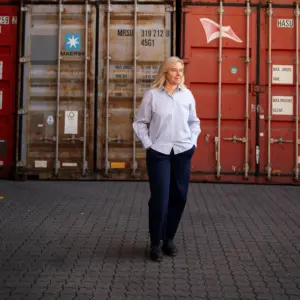
Port of Aarhus provides a practical example.
OceanScore analysed the port’s 2025 vessel calls to understand how its existing incentive scheme would perform under ESI 2.0. Based on projected ESI 2.0 scores, the analysis indicated that around 58 vessels qualifying under ESI 1.0 would no longer meet the port’s existing threshold.
Aarhus subsequently reviewed its approach and decided to introduce a new qualifying threshold of 20 ESI points.
“Choosing an ESI-score threshold is a balance. Too high and it becomes too hard for the shipping companies to reach no matter what the benefits are. We want the threshold to be ambitious and make a difference to the environment, but it only matters when shipping companies work towards it,” says Anne Zachariassen, COO of Port of Aarhus.
The port hopes the change will motivate more shipping companies to work towards higher ESI scores. Rather than treating 20 points as a permanent target, Aarhus will review the threshold annually and expects to raise it over time as environmental performance improves.
The example demonstrates why incentive schemes should not be static. Vessel performance, technology, regulation and the environmental priorities of ports are continually changing. The incentives designed to influence them need to evolve as well.
From better data to better decisions
For ports, creating a modern, state-of-the-art environmental incentive scheme does not need to be complicated. Recognised frameworks such as ESI and EPI provide the basis for measuring performance; actual vessel data shows what will work for the individual port; and the right analysis can translate those insights into thresholds and incentive structures that support the port’s objectives.
The key is not simply having more environmental data, but knowing how to use it. With the right framework, data and expertise, ports can turn environmental performance into better decisions, smarter incentives and a stronger, more competitive port.
 Website
 LinkedIn
 YouTube

Related Articles
 GREENPORT CONGRESS
 DECARBONISATION & SHOREPOWER
 PRODUCTS & SERVICES