



Beyond Hormuz: Redrawing the logistics map
The USA-Israel-Iran war is prompting a massive rethink by the Gulf States on logistics arrangements across multiple cargo sectors. Nishal Sooredoo of Ocean Shipping Conultants, a Haskoning company, identifies the shape of things to come

The Strait of Hormuz remains one of the world’s most strategically important maritime bottlenecks, carrying critical flows of crude oil, LNG, petrochemicals, dry bulk imports and regional containerised cargo. Rather than seeking to replace the strait, Gulf states are pursuing a more pragmatic objective: building resilience through a multi-corridor system and integrated transport networks.
This evolving strategy is reshaping the competitive landscape for ports across the Gulf. While Hormuz will remain the region’s primary maritime gateway for the foreseeable future, investments in pipelines, rail infrastructure and east and west coast ports are creating a more diversified logistics system capable of maintaining trade flows during periods of disruption.
Beyond Bypasses: Building resilience
The UAE and Saudi Arabia are at the forefront of this transformation.
Existing assets such as the UAE’s Abu Dhabi Crude Oil Pipeline (ADCOP) to Fujairah, and Saudi Arabia’s East-West Petroline to Yanbu already provide alternatives for crude exports outside the Strait of Hormuz. New investments are expanding these capabilities through additional pipeline capacity, enhanced export infrastructure and continued development of ports including Fujairah, Khor Fakkan, Yanbu and Jeddah.
But resilience extends well beyond pipelines.
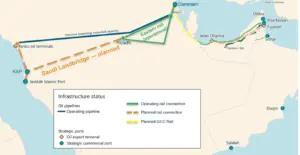
Saudi Arabia’s planned Landbridge railway aims to connect Gulf ports with the Red Sea, Riyadh and major industrial clusters, while the UAE continues expanding rail connections between ports, industrial zones and neighbouring Oman through the Hafeet Rail project. These initiatives are complemented by the proposed GCC Railway and the India-Middle East-Europe Corridor (IMEC), both intended to strengthen regional and international supply chains, although delivery is subject to risks, implementation timelines remain uncertain, and completion is likely to be several years away.
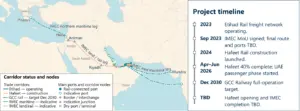
The result is a shift from viewing ports as standalone maritime gateways towards integrated logistics ecosystems that combine ports, rail, road, industrial zones and distribution centres.
Different Cargoes, different outcomes
The impact of these investments varies significantly by cargo type.
Liquid bulk stands to benefit most from new pipelines and bypass ports as crude oil and refined products face the greatest disruption from any restriction to Hormuz. LNG, however, remains far more constrained because of its concentration in facilities within the Gulf and the limited availability of alternative export infrastructure.
Rail infrastructure offers greater advantages for dry bulk commodities, containers and petrochemicals. High-volume cargoes such as sulphur, fertilisers and aggregates can increasingly utilise dedicated rail corridors serving industrial terminals and alternative gateways outside Hormuz. Container networks also stand to benefit from expanded feeder services linked with new rail connections.
General cargo and Ro-Ro traffic, by contrast, remain considerably more dependent on road transport because they serve dispersed inland destinations where flexible trucking continues to offer operational advantages over fixed rail networks. For steel and construction materials, the balance may move from import/export towards local production and consumption.
Winners will be logistics ecosystems
These changing transport patterns are likely to affect Gulf ports differently.
Alternative gateways such as Fujairah, Yanbu, Duqm, Sohar, Salalah, Khor Fakkan and Jeddah could assume greater strategic importance as export, logistics and contingency routing options diversify beyond Hormuz.
Large established hubs including Jebel Ali, Khalifa Port, Jubail and Dammam should remain resilient despite their geographic exposure. Their competitive advantage increasingly lies in integrated logistics capabilities, extensive hinterland connections and diversified industrial activities rather than maritime location alone.
Ports with fewer mature bypass options or more limited integration into regional transport corridors are likely to remain more exposed to prolonged disruptions affecting the Strait of Hormuz. This reflects continued reliance on uninterrupted access through the strait rather than any decline in their operational competitiveness.
Connectivity alone is not enough
Physical infrastructure is only one element of resilience.
The effectiveness of emerging trade corridors will ultimately depend on cross-border political cooperation, customs interoperability and route security. Rail lines and pipelines may provide theoretical capacity, but their operational value depends on seamless regulatory coordination and stable regional conditions.
Consequently, Gulf logistics strategies are increasingly focused on creating multiple routing options rather than relying on a single corridor. The region is evolving towards a multi-corridor transport system that reduces, rather than eliminates, dependence on Hormuz.
For ports, this evolution signals a broader shift in value creation. Future competitiveness is likely to depend less on cargo throughput alone and more on the ability to integrate logistics services, industrial activities, warehousing, free zones and multimodal transport into connected supply-chain ecosystems. In the next phase of Gulf port competition, the winners may not be the ports that handle the most cargo, but those that offer the most reliable, flexible and integrated routes to market.
Nishal Sooredoo is a leading maritime expert with over 20 years of experience in port economic feasibility, market studies, due diligence and transport infrastructure solutions. He works for Ocean Shipping Consultants, a company of Haskoning, the international engineering consultancy, where he advises public and private sector clients on complex port development, investment and strategy projects.

Related Articles
 CONTAINER & CARGO HANDLING
 CONTAINER & CARGO HANDLING
 BULK HANDLING