
Electric on the march
The future is electric for container cranes’ cables and power supply generally, both in terms of newbuilds and retrofits
Sector analysis: Electrification across the new and retrofit markets
The container crane cable, festoon, and power supply market generally is moving quickly towards electrification, while smart cables retrofitting and modernising are key trends. The below company case studies, with their emphasis on battery power, highlight the major focus on electrification in this market. As Jaroslaw Warzecha, Director of the Ports Business Unit at VAHLE says, “Rising diesel prices and volatile energy costs are increasing the economic pressure on port operators. At the same time, regulatory requirements are intensifying the need for low-emission terminal processes. Electrification is thus increasingly becoming not just a question of efficiency, but a key prerequisite for sustainable terminal structures.” The retrofitting market for crane power systems is buoyant in terms of retrofits, both in terms of heavy-duty steel festoons, which remain popular for retrofitting older STS cranes, and modular enclosed energy chains. The industry is also increasingly adopting sensors and IoT integration inside cables to track wear and tear, predict failures, and minimise unplanned downtime.
Data analysis: Electrification, product innovation, retrofits
Aegis: Aegis Critical Energy Defence Corp subsidiary HyprC Systems Corp. (HyprC) has launched its next-generation high-C-rate battery platform, designed for what it calls “the world’s most demanding power applications” in ports, AI data centres and hybrid nuclear energy systems. The launch is supported by a targeted multi-year investment programme and a major research collaboration with Canada’s McMaster University. Highlighting the port application, Canada-headquartered HyprC says: “Modern ports experience violent power swings from equipment such as ship-to-shore cranes, AGVs, reach stackers and yard equipment”. HyprC’s systems are designed to overcome this challenge by enabling rapid opportunity charging between shifts and maintaining stable voltage under heavy lift loads. The company says it also delivers a lower lifetime cost versus diesel and traditional batteries and supports 24/7 operations while helping operators meet decarbonisation and air-quality targets. “For port operators, this combination offers the potential for reduced operating costs, increased asset utilisation and improved regulatory compliance,” it sums up.
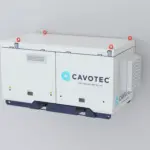
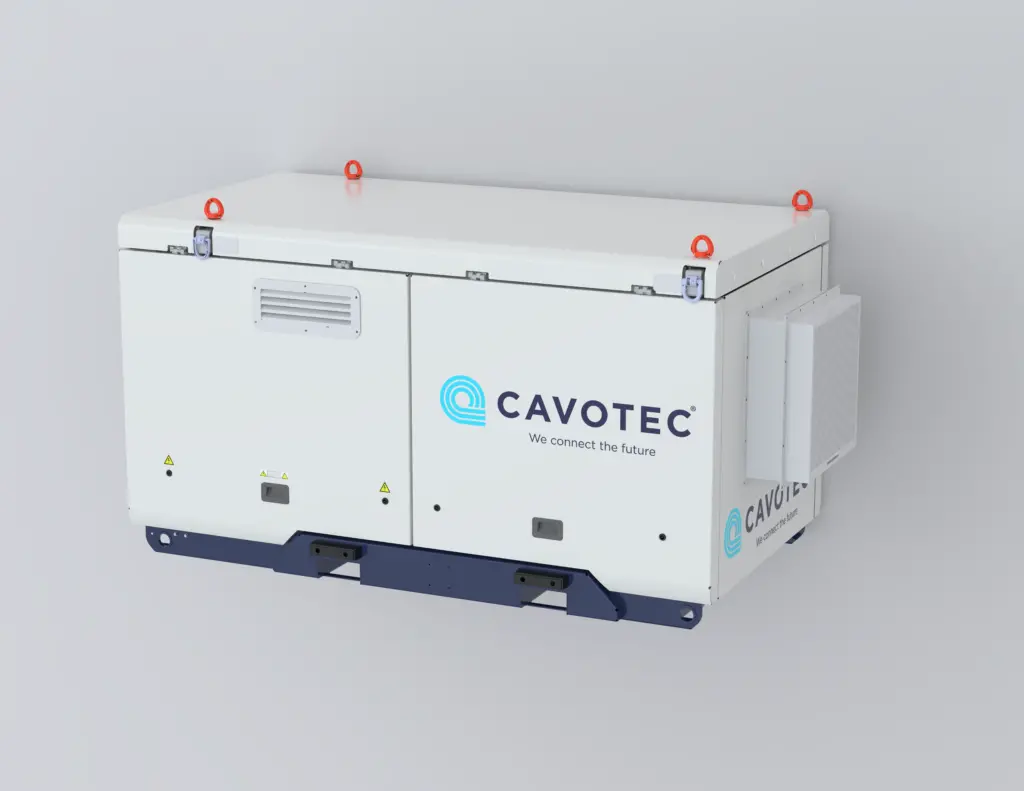
Cavotec: Sweden-headquartered Cavotec has launched PowerAccESS, a modular and mobile battery energy storage system (ESS) designed to support the electrification of port crane operations. Developed for demanding and evolving port environments, PowerAccESS provides zero-emission power for RTG cranes during block changes as a one-to-one replacement for diesel generators. The system, which was announced in May 2026, can also be integrated into existing crane systems as a hybrid power solution, enabling more efficient and sustainable operations. Key features of PowerAccESS include: LiFePO4 batteries for enhanced safety and long service life; scalable battery capacity from 62 to 494 kWh, designed for RTG block change, hybrid or full battery operation; rugged design for harsh marine environments; zero local emissions and low-noise operation. “PowerAccESS represents another important step in Cavotec’s commitment to supporting the transition towards more sustainable and efficient port operations,” says Laurent Dupuis, VP Product Management, Cavotec. “The system has been designed to give crane manufacturers and terminal operators a flexible and scalable solution that reduces emissions while ensuring reliable performance in demanding operating conditions.”
Conductix-Wamplex: Conductix-Wamplex has completed a retrofit project on ship-to-shore container cranes that involved the heaviest motorised festoon system it has ever engineered and built. The project comprised retrofitting one motorised festoon system, including the replacement of the control panel, and the replacement of a non-motorised heavy duty festoon system on another STS crane at Terminal des Flandres in Dunkirk in France. Conductix-Wamplex explained that the scope of the project was system engineering, and in particular the extension of the crane beam required to accommodate its system installation, as well as festoon pre-assembly at the quay, scaffolding installation, and preparation work on the STS cranes to meet the customer’s requirements. A strong focus was on ensuring that crane downtime did not exceed four days. In addition, cable laying and cabling was a major part of the work, with both cable packages weighing approximately 50 kg/metre (35 power and control cables). The Germany-headquartered company completed the two retrofits, including commissioning, within four weeks. Elsewhere, the company has signed a framework purchase agreement for Rubber Tire Gantry Crane (RTG) electrification products and services with APM Terminals. Over the past 14 years, Conductix-Wampfler has supplied APM Terminals with 413 energy supply systems for eRTGs (new and retrofitted) and 116 battery systems.
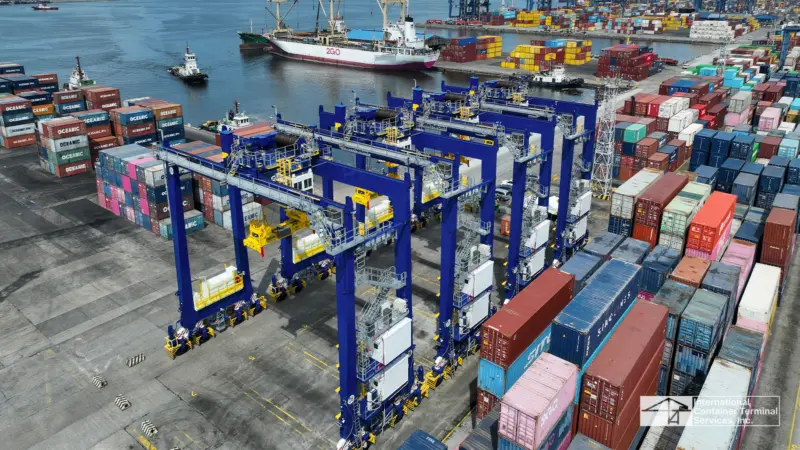
Kuenz: Kuenz has reinforced its focus on providing fully electric power for container terminals, including intermodal ones. Recently, the Germany-headquartered company implemented a project at Norfolk Southern Corporation’s intermodal terminal in Austell, USA, installing six rubber-tyred gantry cranes (Kuenz Freerider RTGs). Each crane was equipped with a fully electric, lithium-ion battery hybrid energy storage system. These batteries are charged via shore power and through the recovery and reuse of energy generated during braking and load lowering. Compared to conventional RTGs, carbon emissions from diesel engines are completely eliminated. For shore-based power supply, there are two main solutions: cable reel systems or conductor rail systems (busbar). Kuenz comments: “The latter option also allows for the integration of the 100% electric hybrid system; in these cases, the lower and constant power demand significantly reduces the infrastructure costs of the conductor rail itself.”
Tratos Group: A recent launch is the TratosFlex-RTG-RF® High Vision Reflective Fluorescent Cable, which is engineered to meet the demands of RTG crane container handling operations. Tratos Group’s high-visibility cable, highlighted at TOC 2025, boosts safety and productivity, especially at night. The Tratosflex-RTG-RF visibility features include reflective stripes which shine with minimal light, like car headlights or smartphones, similar to high-visibility jackets. Its fluorescent compound glows for up to eight hours without external power. The Italy-headquartered company points out that reducing accidental damage to the cable means increased safety and an extended working life, thus increasing the efficiency and productivity of the reeling operation by decreasing downtime. Other benefits include a medium voltage, flexible EPR insulation, and patented technology, which is applied inside the compound itself. The Tratosflex-RTG-RF cable features control, signalling, and bus capabilities for precise communication and efficient container handling. Its flexible design allows easy installation with RTG crane structures.
VAHLE Group: Germany-headquartered VAHLE is focusing on integrated energy systems for electrified crane applications, automated loading and intelligent energy management in terminal operations. To this end, it presented solutions for the electrification of container terminals at TOC Europe 2026 earlier this year. A key focus is on the electrification of RTGs. This area is being developed further with its modular TriMotion Compact system solution. “By replacing diesel-powered generators, up to around 300 tonnes of CO2 can be saved per year and per conversion – depending on the operational profile. This makes the decarbonisation of terminal processes not only technically feasible, but also economically scalable and operationally integrable,” says Jaroslaw Warzecha, Director, Ports Business Unit, VAHLE. In addition, battery-based storage solutions such as the VAHLE Battery Storage System are being deployed, which act as dynamic energy buffers in terminal operations. By providing energy on demand, grid peaks are specifically reduced and power flows within the terminal are stabilised. Thanks to modular and immersion-cooled battery concepts, capacity and performance can be flexibly adapted to different operating profiles.
Yaskawa: Japan’s Yaskawa has developed a hybrid system consisting of lithium-ion batteries and a super capacitor for energy-saving and low CO2 emissions. The system has been adopted into RTGs and container carriers both domestically and overseas.
Explaining the background, Yaskawa said: “We started to develop the system of remote control for container crane and operation assist system because the needs for safety, efficiency and improvement of operators’ work environment are increasing in Asian ports along with the amount of container units.” As well as providing energy-saving and low CO2 emissions, the remote-control aspect of the system for container cranes boosts safety and efficiency and improves the operators’ work environment. Yaskawa first deployed its electric equipment for port cargo handling in 1967, when it installed an electric-powered wharf container crane. Since then, more than 1300 units of quay gantry cranes, 2600 units of RGCs and 200 units of container carriers, mainly in south Asia (Singapore, India and China), have been supplied and are in use.

Related Articles
 EQUIPMENT
 CONTAINER & CARGO HANDLING
 EQUIPMENT