


What to make of the India-middle east-Europe economic corridor?
The recent announcement of the India-Middle East-Europe economic corridor is another step in the efforts of the EU and US to challenge China’s Belt and Road Initiative (BRI) with a competing approach: the Partnership for Global Infrastructure and Investment (PGII).
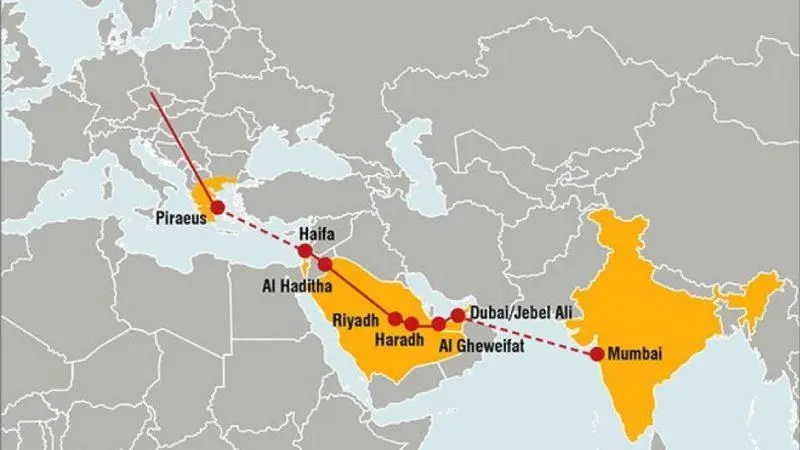
As with the BRI communication, the announcement does not have a great deal of detail. Some unofficial maps seem to suggest a ‘sea/rail/sea journey between Europe and India. However, India’s direct maritime connectivity with Europe is good and will further improve through better port and hinterland operations, especially in India.
A competitive ‘sea/rail/sea’ alternative for the India-Europe trade is in my view not really feasible, even though such an alternative may put pressure on the charges for the Suez Canal. Thus, I doubt this corridor will have a ‘transformative impact’ on maritime transport between India and Europe. Nevertheless, India is obviously happy with this initiative, which strengthens its geopolitical standing and its links to the Middle East. In my view the real potential breakthrough of this corridor is within the Middle East.
The corridor initiative foresees a rail connection between Saudi Arabia, UAE, Jordan and Israel. Such an agreement is plausible given the recent improvement of relations between these countries – and especially Israel and Saudi Arabia. Such a rail connection -and the trade facilitation initiatives/hydrogen pipeline as also announced in the agreement could benefit supply chains within the Middle East and promote economic integration (of some countries) in the region. In addition, such a connection could be valuable for Turkey – not included as a signatory of the MoU. It will take a considerable amount of time before the exact rail corridor will be agreed, designed, financed, built and put in operation. In all likelihood the major financial contribution will have to come from Saudi Arabia, blessed with a budget surplus but a potentially problematic relation with PGII’s values regarding democratic values, good governance, and sustainability. It will be interesting to hear about the progress made at the next G20 summit.
Related Articles
 INSIGHT & OPINION
 INSIGHT & OPINION
 INSIGHT & OPINION