



Asian Market potential enormous
Alex Hughes talks to scrap metal terminal operators in Europe and the US discovering that while prospects for the trade are excellent there are inherent risks in handling the commodity.
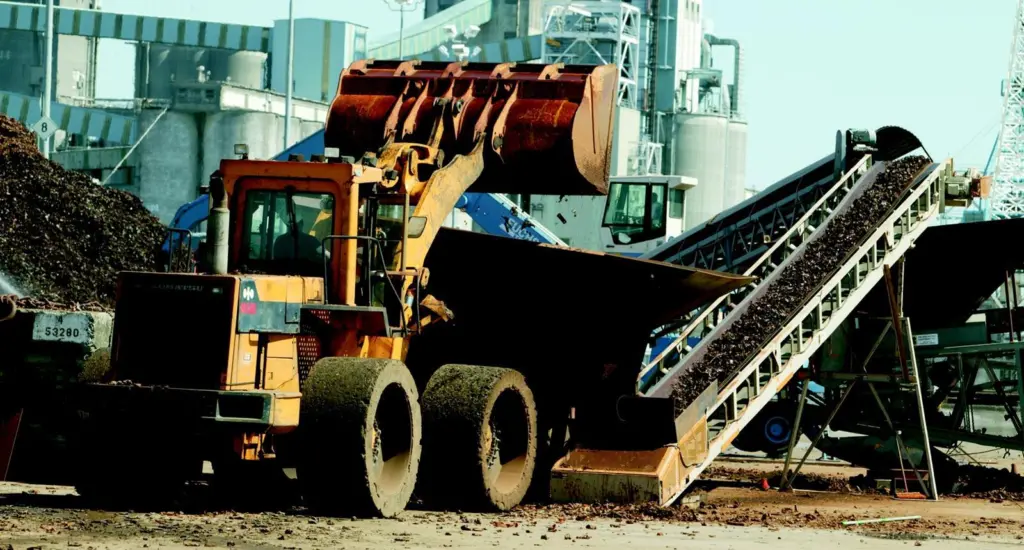
Rotterdam’s Jewometaal scrap metal terminal forms part of ELG Haniel group with 35 processing facilities around the world specialising in the handling of stainless steel scrap. The Rotterdam terminal reported a throughput of 320,000 tonnes in 2004 with volumes rising significantly over the previous year because of increasing demand from India and China – although Taiwan, Spain and Finland are also significant outlets. Paul Bruin, the company’s quality manager, anticipates throughput falling to around 300,000 tonnes for 2005 as a direct result of price corrections in the market.
The price of stainless steel scrap, which is sourced globally by Jewometaal, continues to rise. Scrap containing high levels of nickel for example, has risen from around US$4,500/tonne to US$14,500/ tonne over the last four years alone. At the same time, rising rates for breakbulk have resulted in the majority of such scrap now being containerised. Most of the company’s imports now arrive via Rotterdam’s container terminals, from where boxes are brought by road into the 40,000 sq metre Botlek terminal which has its own direct deepwater access, as well as handling facilities for deepsea vessels and barges. 20,000dwt-30,000dwt breakbulk vessels or container vessels for onward shipment can thus be accommodated.
“Every day, the terminal despatches around 40-45 containers laden with scrap, ” explains Bruin. “However, for markets in both Finland and Spain, we continue to use small breakbulk vessels where freight rates remain at a reasonable level. Whilst most inbound consignments are containerised, Russian imports are an exception from where breakbulk makes more sense because of the overall shortage of available containers there.”
Some mixing of consignments is undertaken at Botlek to segregate scrap with higher and lower nickel contents. This requires extensive sampling of each shipment to achieve an accurate blend.
Some customers want 60% nickel and 10% chrome, while others will want a slightly different mix, explains Bruin adding that customer contracts are usually fixed for no more than 12 months.
HANDLING RISKS Two major problems dog the industry. Unexploded ordinance, although not that common, can occasionally trigger explosions in the terminal!
More worrying is radioactive contamination, which forces Jewometaal to physically screen every shipment of imported scrap at the entrance to the terminal. Every consignment is checked physically too. In addition, Geiger counters have to be deployed on the quayside cranes.
“It is easier to deal with naturally occurring radioactivity than it is to deal with scrap contaminated through industrial processing. In the former case, we send consignments to a plant in Germany where the radioactivity is removed as a slag; the metal itself can then be reprocessed. In the case of industrial contamination, we have to send the material to a specialist plant in south Holland where it might be stored for up to 10,000 years, ” says Bruin, who points out that in 2004 Jewometaal registered 135 instances of radioactive contamination.
“It is part of our business; we have to deal with it, ” he explains.
“Contracts with our suppliers stipulate that they do not wish to receive any contaminated material. If we do send any to them, they remove it and send us the bill for doing so.”
In August 2004, Pacific Coast Shredding undertook its first breakbulk shipment of scrap to Inchon out of the US West Coast port of Vancouver. This consisted of 24,000 tonnes of ferrous metal of which 65% was in the form of industrial scrap and 35% crushed vehicle scrap.
According to Victor Winkler of parent company Metro Metals Northwest (MMN), two such shipments have now been made to South Korea, while several others have been despatched to China.
“It’s been a very successful new market for us. This year, we will probably despatch eight ships to the region amounting to some 200,000 tonnes as breakbulk although additional consignments will also be sent by container, ” he notes.
MNN uses Vancouver exclusively for breakbulk scrap exports but has to truck containers to either Portland or Seattle. While the former is closer, a reduced number of shipping line connections in recent months has left just Hanjin as its only option to move containerised scrap into the Far East. Since this is expensive, Winkler points out that it can often make better economic sense to truck boxes as far north as Seattle.
SHREDDERS EAT THEMSELVES “We have always handled domestic scrap, but prices into end users in the Far East are now highly attractive and we felt we therefore had to be in the export market. Users out there want heavy metal scrap and also shredder scrap. Unfortunately, there are only a very limited number of shredders in the US at the moment, ” Winkler observes, stressing that the shredder operation is not easy, given that for every one hour of operation, an additional hour of maintenance is also required. “If you therefore run a shredder for 12 hours, you are then faced with 12 hours of downtime, because shredders essentially try to eat themselves!
“We see the exporting of scrap to the Far East as having enormous potential for a very long time, ” says Winkler. “Despite the Korean market being a bit slow at the moment, Chinese manufacturers are very busy. In addition to other established markets like Taiwan, there are also emerging markets including India, Thailand and Malaysia, any of which could become the next China. So, the future for the scrap metal industry is going to be excellent.”
Commenting on the various problems facing the company, Winkler emphasises that MMN does not buy ordnance so explosions are not considered to be a risk. As for radioactive contamination, the weighbridges deployed at the entrances of the company’s scrap handling terminals are also equipped with Geiger counters.
“If a Geiger counter goes off, we kick the load out, ” says Winkler, emphasising the company’s no-nonsense approach. “Radiation can be a major headache in this business which is why we have detectors. Fortunately, the only incident I can recall us having was when loading scrap for domestic consumption. One railcar was found to contain contaminated material so we had the whole load sent back to us by our customer which was very expensive. As a result, today, we even use handheld Geiger counters to check each and every load prior to despatch. As far as we are concerned, the onus is on the people we source the scrap from to remove radioactive material before they send it to us.”
The northern Spanish port of Pasajes handled 2.35m tonnes of imported scrap in 2004, compared to 2.28m tonnes the previous year. Given that market prices for scrap are currently on a downward trend, throughput for this year is not expected to pass the 2.1m tonne mark. In addition, several companies linked to the importation of scrap have recently been sold.
Related Articles
 CONTAINER & CARGO HANDLING
 TERMINAL OPERATIONS
 CONTAINER & CARGO HANDLING